How to Schedule Medical Specialists for Optimal Efficiency and Patient Care

 April 6, 2026
 6 min read
How to Schedule Medical Specialists for Optimal Efficiency and Patient Care


Effective healthcare scheduling requires understanding not only who is delivering care and what services are provided, but also where they happen.
Single-site providers, such as an emergency medicine physician employed by a single ER, consistently work at a fixed location. Their schedules are shift-based and relatively consistent. Mobile providers like travel nurses, PRN, and home care workers visit various sites: hospitals, clinics, skilled nursing facilities, patients’ homes, pharmacies, and other community health sites. Their schedules may vary significantly depending on site capacity, scheduling needs, and staff availability at each site.
But multi-site providers, who rotate through a set of separate clinical locations, experience elements of both. Multi-site providers represent a significant share of skilled healthcare workers—as many as 63% of physicians are multi-site providers, and the majority of these are specialists—and face unique challenges.
Medical specialists working across multiple care sites need effective, user-friendly scheduling tools to succeed. And operations teams at each site need AI-powered and user-friendly technologies to support workers, maximize productivity, and manage expenses.
63%
71%
Challenges of scheduling medical specialists across multiple sites
Different sites have their own administrative processes, tech and IT setup, and communication preferences. This makes it difficult for specialists to coordinate schedules across sites and get a clear, up-to-date view of upcoming appointments.
Consider specialists like radiologists and anesthesiologists. They are often needed at multiple hospitals and other clinical sites that require their expertise. But their scheduling needs are complex:
- Subspecialties inform the range of services they provide
- Qualifications may require them to provide or work under physician supervision
- Last-minute changes and urgent procedures
- Procedures can vary significantly in length
A multisite anesthesiologist, for example, interacts with patients and colleagues at each site regularly. But it requires them to toggle between multiple systems, processes, and communication tools.
This takes a toll on the workforce: The American Society of Anesthesiologists says scheduling is one of the top three short-term solutions to alleviate workforce challenges in anesthesiology.
| Challenges of multi-site medical specialist scheduling | What specialists need |
|---|---|
| Hours of operation. Specialists may work in ambulatory care settings — such as clinics, surgical centers, or imaging centers — that have fixed business hours. They may also work traditional rotations and provide on-call availability in 24-hour facilities such as hospitals and freestanding emergency departments. | Smart scheduling that can be customized to their availability at each setting, preventing double bookings or mismatched appointments, and adhering to regulatory best practices concerning duty hours and adequate rest. |
| Varying IoTs and SOPs Individual sites may use their own Practice Management (PM) or Electronic Health Record (EHR) systems, which often silo important scheduling information, limiting visibility into potential conflicts or errors. Administrative teams at different sites have varying best practices and communication platforms, which further inhibits coordination across sites and lead to confusion (or costly downtime) for providers. | What specialists need: Tech that centralizes critical data for flexible scheduling that minimizes downtime and unnecessary travel, and real-time messaging that is coordinated with all work sites. |
| Expertise, subspecialties, and qualifications Seniority and sub-specialty inform provider availability when scheduling appointments accurately. Examples include differentiating between cardiac, neuro, pediatric, or obstetric anesthesiologists, or pediatric, oncology, cardiac, or interventional radiologists, and adequately ensuring coverage if a particular specialist is absent. Providers with greater tenure, such as private practice partners, may also have limited or extended availability at different times of the year. Provider certifications also dictate what types of appointments they can be matched to: for example, a certified registered nurse anesthetist (CRNA) or a certified physician assistant (CAA) must typically be supervised by a physician anesthesiologist. | What specialists need: Software that incorporates seniority, sub-specialty, qualifications, and credentials alongside other scheduling variables to ensure providers are appropriately matched to shifts and appointments with relevant supervision, if necessary. |
| No-shows, last-minute cancellations, and urgent appointments Patients may have to cancel due to unforeseen circumstances, they might no-show, or they may have to reschedule their appointments unexpectedly because they aren’t medically ready - certain types of anesthesia and imaging require patient prep, such as fasting, for example. Emergency procedures or procedures that run longer than scheduled can also change provider availability over the course of a shift. The cost of unfulfilled appointments stemming from last-minute changes erodes operational efficiency, since specialists are higher-cost providers. | What specialists need: Responsive scheduling that accommodates last-minute changes across all locations from a single view, and communicates schedule updates in real-time to providers wherever they are, regardless of connectivity. |
| Productivity Metric | Manual Process | Skedulo Optimized | Impact Delta |
|---|---|---|---|
See how Skedulo helps healthcare organizations schedule, manage, and empower their specialists
Download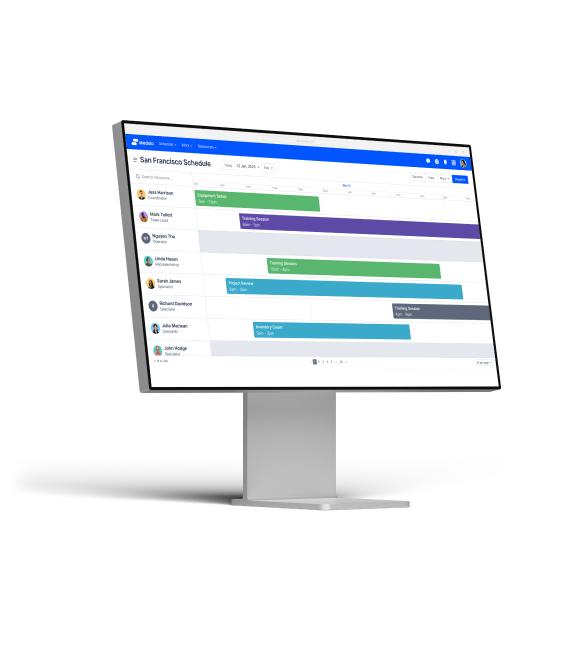
See how Skedulo helps healthcare organizations schedule, manage, and empower their specialists
Download
How to optimize scheduling for anesthesiology, radiology, and other multi-site specialists
Unnecessary travel or poor utilization of highly skilled specialists is not only frustrating, but it’s also expensive. But manually scheduling multi-site specialists is slow and error-prone, especially for large healthcare organizations coordinating hundreds or thousands of providers’ schedules.
The key to effectively scheduling anesthesiologists, radiologists, technologists, and other specialists is smart scheduling. Automated scheduling takes the guesswork out of specialists’ schedules by leveraging pattern recognition and AI to optimize appointment matching, streamline scheduling, and improve communication. The result is more accurate, timely, and user-friendly systems that enhance clarity and job satisfaction.
Here are four key principles to improve scheduling for medical specialists:




1. Integrate scheduling and HR data for optimal appointment matching
Matching the right specialist to the appointment—ensuring they are qualified, available, and at the correct location—is complex. Smart scheduling software combines scheduling data (hours of operation, individual work schedules, patient preferences) with HRIS data (qualifications, credentials, subspecialties) to systematically match specialists to the right appointment.
Decision intelligence based on all relevant data sources enables administrative staff to schedule more appointments quickly, and in-demand specialists to get accurate schedules faster. With a centralized smart scheduling system, schedulers and dispatchers have better visibility into site schedules. This enables higher-level team planning, such as ensuring Certified Registered Nurse Anesthetists (CRNAs) and Certified Anesthesiologist Assistants (CAAs) are appropriately staffed with physician anesthesiologists, or ensuring radiologists with specific sub-specialties are on-site at the same time as other providers they support.
With visibility into real-time scheduling demands, leaders can adjust staffing levels to ensure adequate coverage for each location and shift. This minimizes downtime and unnecessary travel for higher-cost specialist roles, and proactively addresses everyday healthcare scheduling bottlenecks that impact operational performance and patient satisfaction. In fact, recent research shows that patient satisfaction drives patient volume in outpatient radiology.
2. Use mobile-first, user-friendly tools to share updates
Last-minute cancellations, changes, and no-shows are unfortunately common in the healthcare industry. Patients may need more time to prepare for a procedure adequately, the procedure itself may change or take longer than anticipated, or unforeseen circumstances may lead to a cancellation or delay.
Without the right system to track and communicate these changes, they frustrate staff and lead to unnecessary travel. Timely communication also directly impacts reimbursements and insurance authorizations. Not surprisingly, 71% of Skedulo’s healthcare customers cite operational efficiency as a key goal of their scheduling practices.
Multi-site specialists need an agile, secure, mobile-first scheduling tool that immediately shares updated schedules and relevant appointment data. For example, anesthesiology scheduling is uniquely dynamic, subject not only to appropriate subspecialty matching but also to frequent cancellations, emergency procedures, or procedures running long. Smart scheduling apps empower anesthesiologists to make schedule changes in real time without compromising care for other patients.
3 days
$1.6M
3. Deploy scheduling systems within existing tech stacks
When specialists work at multiple facilities with different EHR/EMR/PM systems, these tools need to be integrated, interoperable, and adaptable. This equips specialists to review procedure details, patient medical history, and treatment plans for upcoming appointments on their schedule.
Interoperability also helps operations leaders review trends in patient attendance, procedure durations, claims data, and reimbursement speeds. These insights inform operational strategies that improve provider efficiency and the patient experience:
AI-driven scheduling platforms don’t just look at immediate conditions; they also analyze historical data to continuously improve operations. The holistic integration of cross-functional data ensures that these efficiencies fulfill a practice’s Meaningful Use standards while delivering higher-quality, cost-effective care to more patients.
Real-world result
Analyzing scheduling and claims data helped one multi-site radiology department reduce its scheduling time from six weeks to three days and secure $1.6 million in additional revenue.
4. Improve visibility with customizable, real-time dashboards
Managers, schedulers, and dispatchers need visibility into real-time conditions and upcoming appointments to best support multi-site specialists. By setting up dashboards that pull in scheduling and employee data, they can identify and address issues—e.g., overlapping appointments, insufficient travel time, and coverage gaps in certain necessary subspecialties—that would otherwise impact staff.
Scheduling platforms can readily integrate data for real-time insights into KPIs like:
- employee utilization and staffing across departments and specialties
- providers’ travel time and downtime between facilities and appointments
- compliance with provider duty hours, documentation, Meaningful Use objectives, HIPAA, and other regulatory standards
- patient wait times, cancellations, and no-show rates
- patient satisfaction and experience feedback
Visibility into the workforce helps front-office staff make real-time accommodations for changing conditions or delays, keeping providers efficient and patients satisfied. Staff who are better utilized are also more likely to be positively engaged with their patients and less subject to burnout or early turnover. It can cost millions to replace a physician due to burnout, so it benefits practice managers to put specialists in a position to succeed as much as possible.
Find the right scheduling platform for your multi-site practice
The Skedulo Plus mobile app helps radiology and anesthesiology providers schedule, manage, and empower their specialists, regardless of location. Specialists can see their upcoming appointments, securely view patient details, and receive schedule updates in real time.
Skedulo is simple to use, with customizable views for staff, schedulers, and leaders. Skedulo integrates easily with Salesforce, Zendesk, Epic, Workday, and more—and the Lens API connects our smart scheduling to your own PM system and custom apps.
Schedule a demo to see Skedulo in action.
Join the growing list of readers receiving real-world insights on AI scheduling, field operations, and workforce innovation from Skedulo.
-
 Real operational insight
-
 What's changing in the industry
-
 Product thinking that helps you move faster
Communications are limited to relevant news and insights.
Join the growing list of readers receiving real-world insights on AI scheduling, field operations, and workforce innovation from Skedulo.
-
Real operational insight
-
What's changing in the industry
-
Product thinking that helps you move faster
Communications are limited to relevant news and insights.